
SINCE 1988
203-546-7793
Key Takeaways
✔ A quitclaim deed transfers whatever interest the grantor has in a property but provides no guarantees about a clear title or ownership.
✔ Quitclaim deeds are best used between trusted parties—such as family members, spouses, or internal business entities—because they offer minimal protection to the recipient.
✔ Common uses include divorce settlements, adding or removing a spouse from a title, gifting property, correcting title errors, transferring to a trust, and resolving boundary issues.
✔ Risks include inheriting liens, tax debts, or legal disputes, and a quitclaim deed does not remove a person from an existing mortgage.
✔ Professional guidance from a real estate attorney, title company, or local expert is essential before signing a quitclaim deed to avoid costly mistakes.
If you’re facing a property transfer—whether during a divorce, updating your title after marriage, or gifting a home to a family member—understanding how a quitclaim deed works can save you time, stress, and costly legal missteps. Many use this tool every year, but few fully understand the risks, limitations, and best-case scenarios.
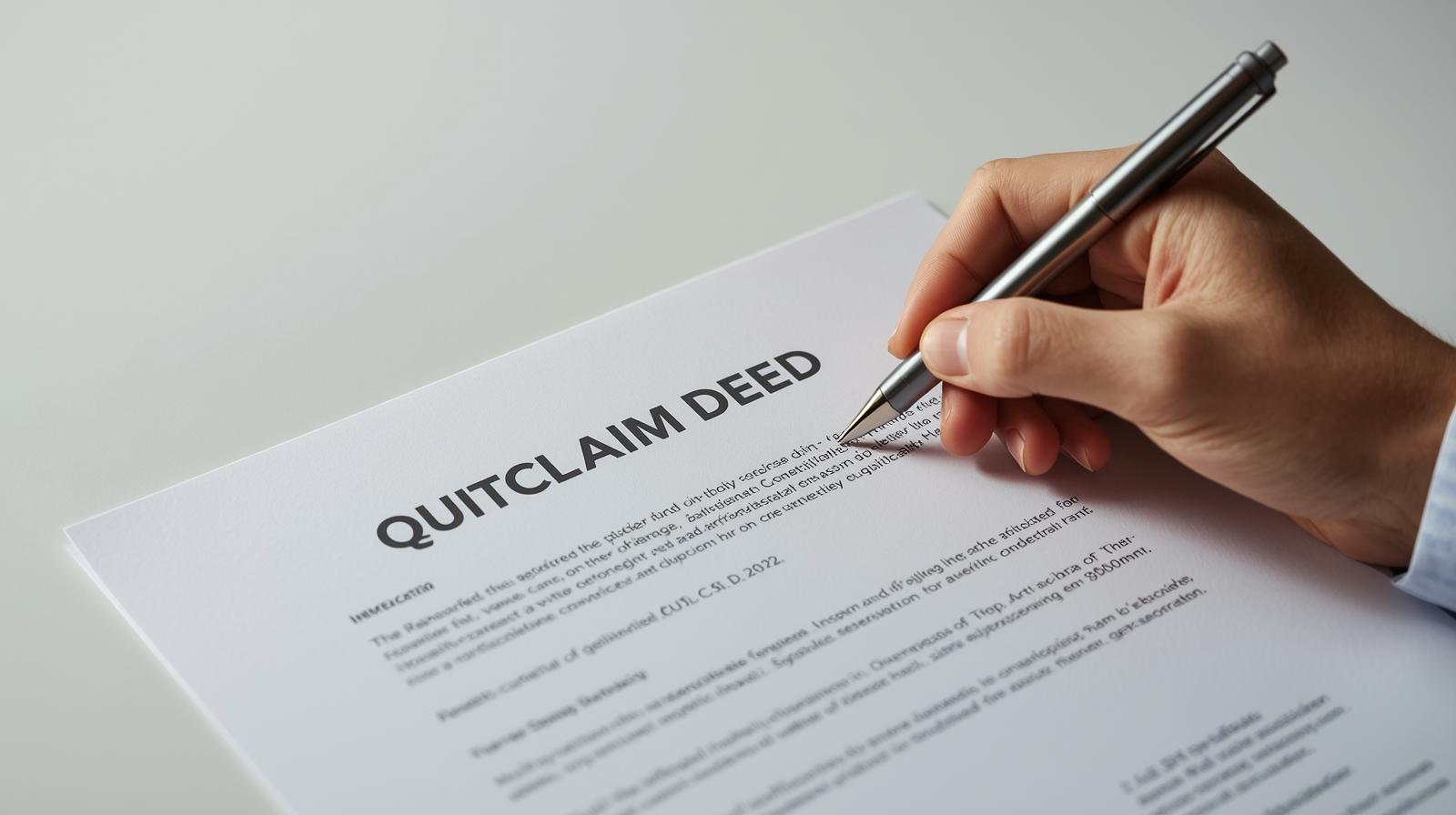
A quitclaim deed is one of the simplest tools available for transferring property ownership from one person to another. It’s often used between family members, spouses, or trusted parties because it transfers whatever interest the current owner has—without guaranteeing a clear title.
If you’ve ever wondered what is a quitclaim deed and why it’s so commonly used, the short answer is this: it’s fast, straightforward, and inexpensive compared to other deed types.
When someone signs a quitclaim deed, they’re saying, “Whatever rights I have in this property, I give to you.” They’re not saying they do have full rights, nor that the property is free of liens or disputes.
When you look at what a quitclaim deed does, the answer is surprisingly straightforward: it transfers the grantor’s interest “as-is.” It does not verify whether the grantor owns the entire property, owns only part of it, or whether claims or liens exist.
That’s why attorneys recommend using a quitclaim deed only in situations where both parties trust one another or where ownership conditions are already clear.

Not every property transfer requires legal battles or complex title processes. In fact, some of the most common real-life scenarios in residential real estate are ideal for quitclaim deeds.
Here are the most typical situations where a quitclaim deed is the right tool:
When a couple divorces, one spouse often needs to remove their name from the property title. Using a quitclaim deed ensures a clean and cooperative transfer, allowing one spouse to take full ownership. It’s one of the most efficient ways to legally update ownership during marital transitions.
Marriage often prompts couples to unify ownership. Couples frequently use a quitclaim deed to add a new spouse to the title of a home purchased before marriage. It’s simple, fast, and widely accepted across the U.S. recording offices.
Parents gifting a home or family land to children often choose a quitclaim deed because there’s no need for warranties between trusted parties. A property gift doesn’t require the same protections that come with a sale, making this method ideal.
If you’re moving your home into a revocable or irrevocable trust for estate planning, a quitclaim deed keeps the process straightforward.
Misspelled names, incorrect legal descriptions, or clerical mistakes happen. A quitclaim deed makes correcting these errors quick and inexpensive.
Neighbors sometimes transfer small slivers of land to resolve boundary conflicts. Because these transactions are typically small and low-risk, quitclaim deeds fit the situation well.
Whether transferring property to an LLC you own or restructuring internal ownership among business entities, quitclaim deeds provide a simple and efficient solution.
Each of these situations occurs regularly across American residential real estate, making quitclaim deeds a familiar part of property law.

While both parties can benefit, the grantor—the person transferring the property—usually gains the greatest advantage. Because the grantor isn’t guaranteeing a clear title, they’re shielded from liability if issues are later uncovered. This is a significant reason experts emphasize due diligence when exploring what is a quit claim deed compared to other forms of transfers.
However, the grantee—the person receiving the property—also benefits in certain circumstances. When transferring property between family members or trusted parties, the simplicity of the process can save time and legal expenses. Especially in residential real estate, where trust-based transfers are common, quitclaim deeds can be extremely helpful.
Despite their benefits, quitclaim deeds carry a reputation for risk. Professionals often point out that when you ask what does a quitclaim deed do, the answer includes a substantial lack of protection. That’s the main reason for the negative perception.
Quitclaim deeds are often viewed negatively because:
In short, while a quitclaim deed is a powerful tool, it’s not the right solution for every real estate transaction—especially those involving strangers or arm’s-length deals.
Understanding the repercussions of a quit claim deed is essential before signing, because while quitclaim deeds can simplify a property transfer, they also come with real risks.
Although there’s no national data tracking quitclaim deed fraud specifically, the FBI reports that from 2019 to 2023, 58,141 victims lost more than $1.3 billion to real estate–related fraud. This underscores how vulnerable property transfers can be—especially when a deed offers no title guarantees and limited protections.
If the grantor never had true ownership, the grantee receives nothing—and typically cannot sue. The deed only transfers whatever the grantor had, even if that’s zero.
The grantee may inherit:
Financial surprises are a major portion of the repercussions of a quit claim deed and one reason buyers are rarely willing to accept this deed type in typical real estate sales.
Some title insurance policies may be voided after a quitclaim transfer. Always check your policy to avoid unexpected issues during future refinances or sales.
A quitclaim deed does not remove someone from the mortgage. Even if a spouse signs away their ownership, the lender still holds them responsible unless the loan is refinanced or formally modified.

Taxes on quitclaim transfers vary widely based on circumstances and state laws.
Here are the most common tax considerations:
If you transfer property without receiving payment (or for a very small amount), the IRS may consider the transfer a gift. Depending on value, a gift tax return might be required.
Many states charge transfer taxes or recording fees, regardless of deed type. Even a simple quitclaim deed between family members can trigger state taxes.
Capital gains are usually assessed when the recipient eventually sells the property—not during the quitclaim transfer—but it’s still important to understand long-term implications.
If you’re using a quitclaim deed for estate or tax planning, talking with a CPA or tax attorney is one of the smartest steps you can take.
Before finalizing a quitclaim deed, experts recommend evaluating several important risks.
The grantee receives the property “as-is.” If you’re unsure about the property’s status, a title search is essential.
A quitclaim deed doesn’t affect who owes the mortgage. Only refinancing or a lender-approved release can change that.
If a buyer is involved, a warranty deed almost always provides better protection.
In some states, a quitclaim deed may void or complicate title insurance coverage—especially when transferring partial interests or changing ownership structure.
A warranty deed is usually better for:
Knowing when not to use a quitclaim deed is just as important as understanding what is a quit claim deed in the first place.
Filing a quitclaim deed involves several steps, and accuracy matters:
While the process is relatively simple, mistakes can cause major delays or legal issues. Professionals often recommend verifying title details and confirming your county’s recording requirements before filing.
Reversing a quitclaim deed after recording isn’t simple because the transfer is legally binding. In most cases, both parties must agree to sign another deed transferring the property back. If one party refuses, the only option may be a legal challenge, which can be time-consuming and expensive. Courts typically require strong evidence to undo the transfer.
A quitclaim deed can still be legally valid even when no money changes hands. Many of these transfers are gifts or internal transfers between trusted parties. However, recording offices may still require the deed to show nominal consideration for administrative purposes. Tax implications may also arise depending on the situation.
Yes, a quitclaim deed can transfer partial ownership when the grantor only holds a share of the property. The grantee simply receives whatever percentage the grantor legally owns. This can happen with inherited properties or jointly owned real estate. It’s important to clearly document the ownership structure before transferring.
Quitclaim deeds do not expire once they are properly signed, notarized, and recorded. The transfer remains in effect unless a new deed is filed to change ownership again. The only time validity becomes an issue is when the deed was incorrectly executed or never recorded. Always verify that the deed is officially filed with the county.
An attorney isn’t legally required to prepare a quitclaim deed, but many people choose to involve one. A lawyer can ensure the deed is properly drafted, executed, and recorded. They can also help identify any potential issues with ownership, liens, or tax implications. Professional guidance reduces the chance of errors.
Professional support can make all the difference when navigating property transfers, deed questions, or real estate decisions in Newtown, CT. With decades of proven experience, Tower Realty Corp—a full-service commercial, industrial, and residential real estate brokerage—provides trusted insight and local expertise for individuals and businesses across Newtown, CT. Whether handling title updates, preparing for a sale, or evaluating transfer options, Tower Realty Corp delivers clear direction backed by deep market knowledge in Newtown, CT.
Contact Tower Realty Corp today to get personalized assistance and move forward with confidence.
Disclaimer
This article is for informational purposes only and does not constitute legal, financial, or tax advice. Real estate laws and requirements vary by state and individual circumstances. Before using a quitclaim deed or making any property transfer decisions, consult a qualified attorney, tax professional, or real estate expert to ensure compliance with local regulations and to understand any potential risks or obligations.